Foundations Lost to Abstractions
Every layer of abstraction makes software easier to build and harder to understand. Here’s what that costs, and how to build things that last.
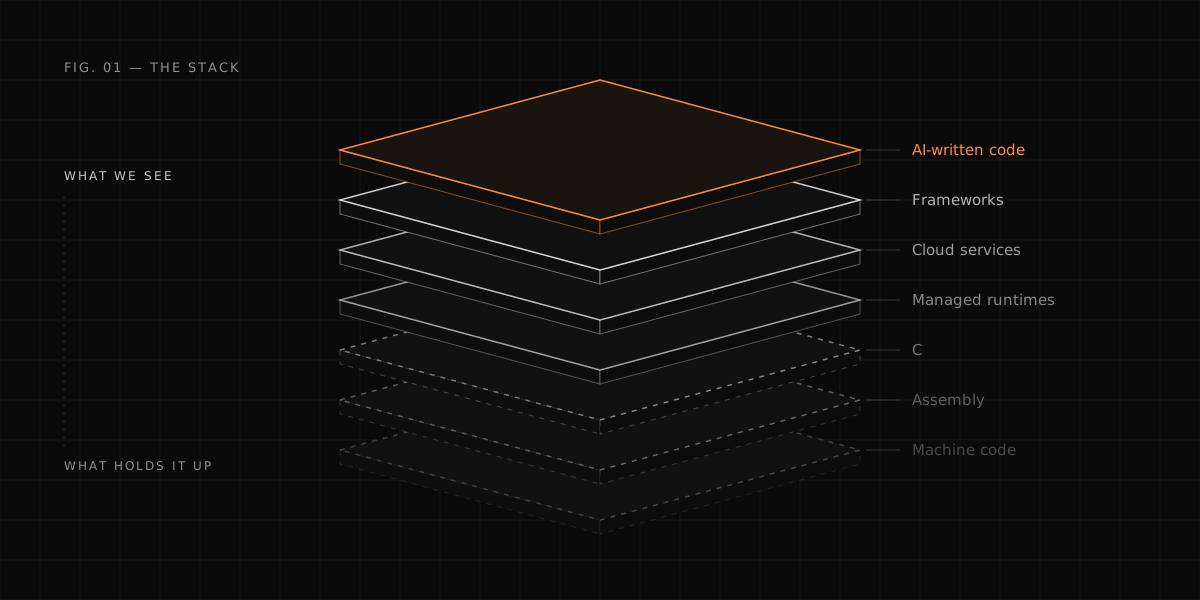
Climbing the stack
The history of programming is a history of abstraction: machine code, then assembly, then C, managed languages, frameworks, cloud services, low-code tools, and now AI that writes code from a sentence of English. Every step was a real gift. More people could build, faster, with whole classes of bugs gone.
But each step also moved knowledge from “something every programmer knows” to “something a specialist knows,” and eventually to “something almost nobody knows.”
Abstraction isn’t the villain of this story. Forgetting is.
Where the floor shows through
In 2002, Joel Spolsky described the Law of Leaky Abstractions: every non-trivial abstraction eventually leaks. The details it hides push their way through.
- An ORM that quietly fires a thousand database queries for one page load.
- “Serverless” cold starts: the servers showing through.
- Floating-point rounding that turns into real money in financial code.
- “Globally distributed” apps that all go down with one cloud region.
When an abstraction leaks, you need someone who understands what’s underneath. The uncomfortable question is whether we’re still producing enough of those people.
The permanence paradox
Software feels temporary. Apps update weekly and frameworks rise and fall in a few years. Yet banks still run COBOL, kernels carry decades-old C, and tiny libraries for compression and time zones sit inside billions of devices.
The software that lasts tends to sit close to the foundation: simple, well understood, boring. Permanence doesn’t go to whatever is newest. It goes to whatever is understood.
The dependency tower
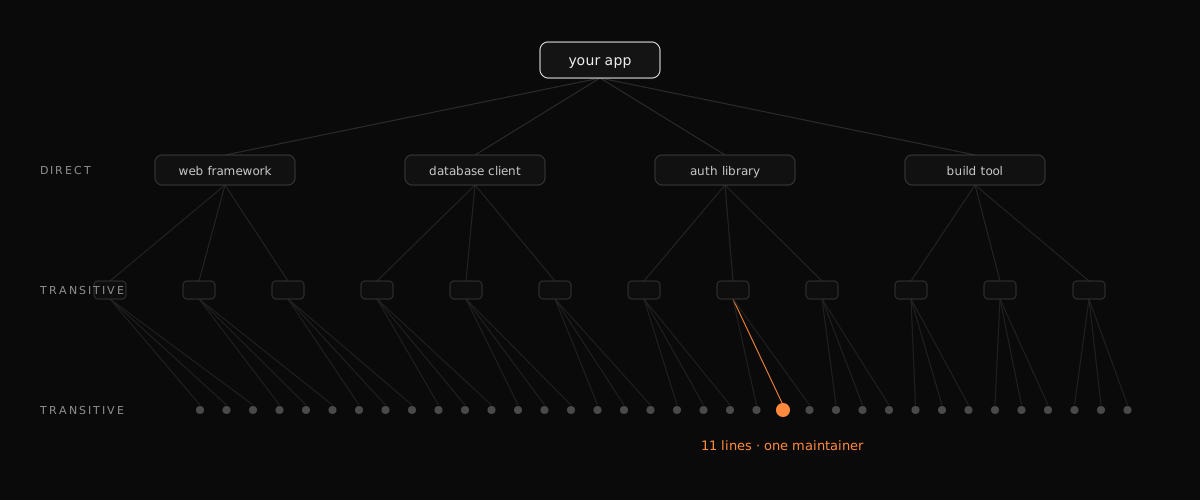
The lesson isn’t that open source is dangerous. It’s that abstraction spreads code out while concentrating risk on a handful of maintainers, often unpaid, whom most users have never heard of.
When the last person who knows retires
Knowledge rarely vanishes all at once. It leaks out one retirement, one reorg, one “we’ll document it later” at a time. In 2020, as unemployment claims surged, several US states publicly asked for volunteers who knew COBOL.
AI-assisted coding adds a new twist: for the first time, we can produce large amounts of working code that no human ever fully understood. Being able to use a system is not the same as being able to repair it.
Building for permanence
- Engineers: learn one layer below the one you work in. Read the framework’s source. Debug past it, not around it.
- Teams: write down why, not just what. Keep systems small enough to understand. Treat dependencies as liabilities.
- The industry: fund critical maintainers, keep teaching fundamentals, and choose boring technology for things meant to last.
Digging back down
On an ordinary day, nobody in the tower thinks about the pilings. They matter when the ground moves. Software has its own moving ground: security crises, outages, a vanished dependency, the last expert retiring. Abstractions are how we climb higher. Foundations are why we don’t fall.
The best engineers aren’t the ones who never need the foundation. They’re the ones who know where it is.